
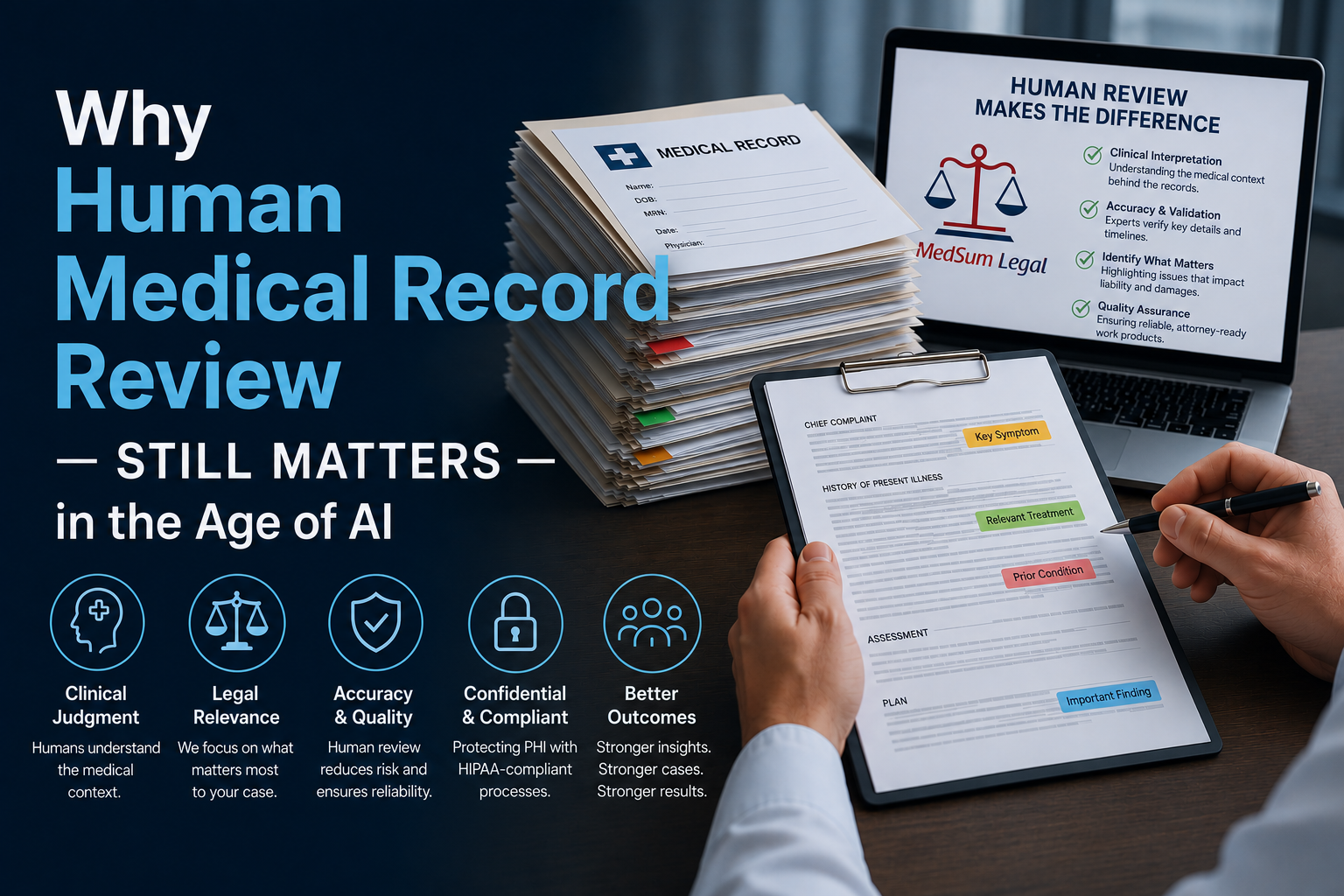
Artificial intelligence has become an integral part of our everyday lives. From online searches and virtual assistants to workplace automation, AI is transforming the way we work. The legal and healthcare industries are no exception. Today, AI in medical record review can scan thousands of pages within minutes, extract treatment dates, organize medical chronologies, and assist with medical record summarization.
This advancement is similar to the era when computers first entered the workplace. Initially viewed as an optional tool, computers eventually became indispensable. AI is following a similar path by enhancing productivity and reducing repetitive work.
However, an important question remains: Can AI replace human medical record review? The answer lies in understanding what medical record review truly involves.
Medical Record Review Is More Than Summarizing Records
Many people believe that medical record review simply involves reading medical records and preparing a chronology. In reality, it is a much more comprehensive process.
Every claimant has a unique medical history, different injuries, and a different recovery journey. Even when two claimants are involved in similar motor vehicle collisions, the mechanism of injury, treatment progression, emotional response, and long-term outcome can be entirely different.
A reviewer must determine whether the documented injuries are consistent with the mechanism of injury, identify pre-existing conditions, analyse causation, evaluate treatment progression, and understand how the injuries have affected the claimant’s activities of daily living (ADLs).
For professionals reviewing personal injury medical records, every page contributes to the overall story. Medical record review is not simply medical record summarization; it is the process of understanding the complete medical picture.
Where AI Adds Value
There is no denying that AI has improved efficiency.
AI can quickly scan medical records, extract treatment dates, identify healthcare providers, organize medical chronologies, perform keyword searches, and prepare preliminary summaries. These repetitive tasks previously required significant manual effort and can now be completed much faster.
For law firms and medical record review professionals, AI is an excellent productivity tool that reduces administrative work and allows reviewers to spend more time analyzing the case.
Used correctly, AI improves efficiency without replacing professional expertise.
Why Human Medical Record Review Matters
While AI can organize information, it cannot independently analyse a claimant’s medical journey with the depth and reasoning required in medical record review.
Experienced reviewers spend days reviewing records page by page and line by line. As they prepare a medical chronology, they gradually understand the claimant’s injuries, treatment progression, emotional struggles, financial burdens, and changes in daily life.
In many ways, reviewers travel alongside the claimant throughout the case.
They identify inconsistencies, connect related medical events, evaluate whether injuries are consistent with the mechanism of injury, recognize aggravation of pre-existing conditions, and determine whether additional treatment may be related to the original incident.
This level of analysis requires judgment, critical thinking, and experience; qualities that cannot be fully automated.
Human reviewers also recognize emotional trauma, lifestyle limitations, and subtle clinical details that may significantly affect a personal injury claim and the overall settlement value.
Human Review Connects the Missing Pieces
One of the greatest strengths of human medical record review is the ability to connect information that is not explicitly documented.
Medical records rarely present the entire story in one place. Instead, reviewers must analyze multiple providers, imaging reports, therapy notes, specialist consultations, and follow-up visits before reaching a conclusion.
Sometimes, the most important connection is never directly stated within the records. Recognizing these patterns often makes a significant difference during demand letter preparation, where every medically supported injury contributes to presenting an accurate picture of the claimant’s damages.
Real-Life Examples from Medical Record Review
Example 1: Recognizing Secondary Injuries
One claimant initially reported foot pain following a motor vehicle collision.
Several months later, she developed knee pain and hip pain. None of the treating providers had clearly documented that these complaints were related to the collision.
However, during the medical record review, several observations stood out. The claimant was relatively young, had no prior history of knee or hip problems, and there were no degenerative findings that could explain the new symptoms.
By reviewing the treatment progression and understanding how gait changes affect the body, it became reasonable to conclude that the altered walking pattern caused by the foot injury contributed to the knee and hip pain.
Later, the treating providers confirmed this exact relationship. Because the connection had already been identified during the review, it strengthened the medical narrative and contributed to the overall value of the claim.
This type of pattern recognition comes from careful human analysis rather than simple data extraction.
Example 2: Looking Beyond the Diagnosis
In another case, a claimant was hospitalized following a traumatic motor vehicle collision.
Several months later, he began experiencing depression and anxiety. Although his symptoms did not meet the criteria for a formal diagnosis of post-traumatic stress disorder (PTSD), the emotional effects were consistently documented throughout multiple medical records.
An AI system focused on identifying formal psychiatric diagnoses could easily overlook these scattered references or classify them as unrelated.
A human reviewer, however, recognized that the emotional symptoms developed after the collision, appeared consistently throughout the treatment records, and reflected the psychological impact of the traumatic event.
Including these findings during demand letter preparation resulted in a more complete presentation of the claimant’s injuries and contributed to a stronger settlement demand.
The Future of Medical Record Review
Artificial intelligence will continue to reshape the way professionals handle personal injury medical records. It is already improving efficiency in scanning records, organizing medical chronologies, and performing medical record summarization.
However, medical record review is not simply about extracting information from documents.
It requires understanding causation, identifying pre-existing conditions, evaluating emotional trauma, and interpreting the claimant’s complete medical journey.
These responsibilities still require human judgment.
Rather than replacing reviewers, AI should be viewed as a powerful assistant that allows professionals to spend less time on repetitive administrative work and more time performing meaningful analysis.
Final Thoughts
The future of medical record review is not a choice between AI and humans; it is a partnership between the two.
AI excels at processing large volumes of information quickly and accurately. Human reviewers contribute critical thinking, clinical reasoning, empathy, and experience that technology cannot replicate.
The most effective medical record review combines the efficiency of AI with the expertise of skilled professionals. By allowing technology to handle repetitive tasks while people focus on analysis, causation, and demand letter preparation, legal teams can produce more accurate, comprehensive, and persuasive work for their clients.
At the heart of every file is a person whose life has been affected by injury. Technology can organize the records, but only human reviewers can truly understand the story those records tell.